
“The enquiry came in March, the survey was April, and I still haven't chased the quote.”
Solar installer software that carries each job from enquiry to handover. Light evenings spent outside, not on paperwork.
Every sale moves on without you nudging it, every form has its date, and your solar business stops living in your inbox.
I'm Daniel Andrews. Alongside running a law firm in East Sussex, I build the systems that keep its work moving. If you fit panels and batteries around Hastings, Hailsham or Uckfield, I'll help you get the admin out of your evenings and build a firm that doesn't need you at every step.
A typical summer evening, after a day on a roof
- 7pmTurning a survey into a designRoof photos, shading notes and meter details
- 8pmQuotes that went quietThree proposals from last month, no reply yet
- 9pmDNO forms and MCS certificatesLast week's installs, each on its own deadline
- 10pmDeposits and kit ordersWho's paid, what's ordered, which scaffold is booked
- 11pmBed, with an app question waitingA customer's monitoring shows zero, and they want to know why
Long days on the roof, longer nights at the laptop
A sale that takes months leaves plenty of loose ends for the evenings.
“Some customers take six months to decide, and by then I've forgotten what I quoted.”
“In June it's light till ten, and so is my paperwork.”
“Deposits in, panels ordered, and I still can't say which jobs actually made money.”
“I found a G98 form I'd filled in and never sent, three weeks after the install.”
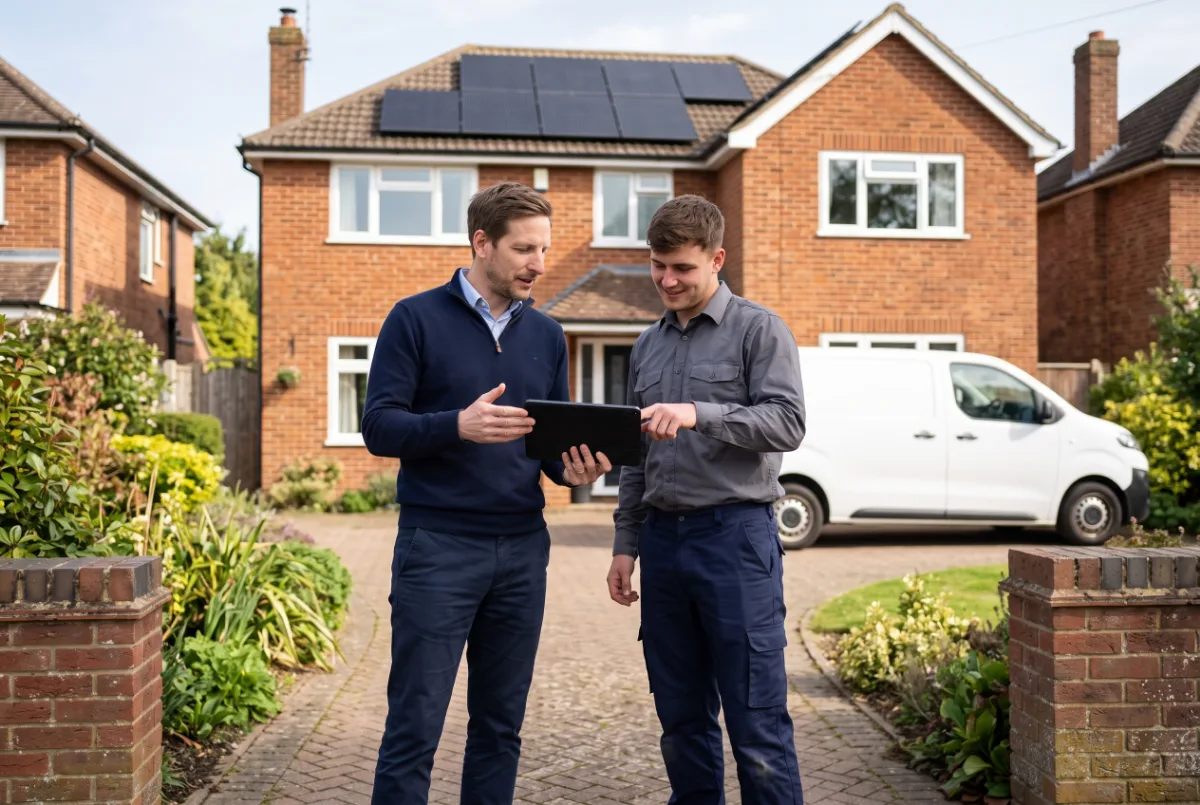
If every sale needs you to push it along, it's still a job
You went into solar to run your own show. But a solar job isn't one visit. It's an enquiry, a survey, a design, a quote, a deposit, an install and a handover, often spread across months, and each step waits for you.
If three weeks off would leave half your pipeline stuck, you've built a job, not a business. I explain why so many trades end up working for the business, not the other way round.
We see where your time goes, then put the repeat work on systems, so each stage runs on rails. The end of one step starts the next, customers hear from you without you typing, and the paperwork gathers as the job goes. You spend the hours you win back on the business, and the process is written down so a second installer could follow it.
What should solar installer software do for a small solar business?
It should move each job through its stages, from enquiry and survey to design, quote, deposit, installation and handover, with a follow-up at each one. It should hold roof photos and designs, track MCS certificates and network operator notifications against their deadlines, and produce a handover pack the customer can keep.
| Job | How it often works now | Set up properly |
|---|---|---|
| Enquiries | Web forms, calls and messages, answered after dark. | One inbox, and a reply asking for the address, a recent bill and roof photos. |
| Surveys and design | Notes on your phone, retyped into the design tool. | The survey form feeds the design, so nothing is typed twice. |
| Quotes and follow-up | Sent, then left to go quiet. | Follow-ups spaced over weeks, because solar decisions take time, stopping when they reply. |
| Deposits and orders | Checked in your banking app. | A paid deposit triggers the kit order and the install booking. |
| DNO and MCS paperwork | Done in a batch when you remember. | Commissioning an install creates each task with its due date. |
| Handover and aftercare | A folder of PDFs emailed at the end. | A handover pack on the day, then a review request once they've seen some generation. |
What paperwork follows a domestic solar installation?
The network operator must be notified within 28 days of commissioning for smaller G98 systems, and must approve larger G99 systems before they connect. Smart Export Guarantee applicants with systems up to 50kW need an MCS certificate or equivalent. Zero-rate VAT on residential installs runs until 31 March 2027.
Telling the network operator
MCS explains that every solar PV install must be notified to the distribution network operator. Under 16 amps per phase, G98 applies and Form B goes in within 28 days of commissioning. Above that, G99 applies and you need permission before connecting. SSEN, one network operator, says most suppliers want its confirmation before an export tariff application, so a late form can delay your customer's export tariff.
MCS and the Smart Export Guarantee
MCS is moving every certified installer onto its redeveloped Scheme by 31 March 2027. Under it, you get 30 days rather than 14 to raise the certificate after commissioning, and domestic jobs need an approved financial protection product.
You may also belong to a consumer code such as RECC or HIES, both approved by the Chartered Trading Standards Institute. Ask your certification body how that fits the new Scheme.
Planning and VAT
The Planning Portal says solar panels on homes may be permitted development, within limits. On a pitched roof, panels can't stick out more than 0.2 metres or rise above the highest part of the roof, chimneys aside, and listed buildings fall outside the right. HMRC's VAT Notice 708/6 zero-rates installing solar panels in homes until 31 March 2027, with the 5% rate from 1 April 2027.
- A commissioning date that sets both deadlines: the network operator form and the MCS certificate.
- Quotes that might be installed after 31 March 2027 flagged for a VAT check with your accountant.
- A handover pack built from the job: certificates, datasheets, the DNO confirmation and how to apply for the SEG.
Please note: this is general information from official sources, not legal or tax advice. For your own situation, speak to MCS or your certification body, your network operator, your accountant or a solicitor.
How many quotes are waiting on a reply right now? Tell me, and I'll show you follow-ups that send themselves.
Book a free 30-minute callWhat I'd set up first for a solar installer
The sale first, because a long cycle loses customers quietly. Then the deadlines.
One pipeline, every stage
Each job shows its stage and next step, so you see which surveys need designs and which quotes need a nudge.
Follow-ups for slow decisions
Messages spaced over weeks answer the usual questions on export payments and batteries, stopping when the customer replies.
Commissioning starts the paperwork
Marking a job commissioned creates the network operator and MCS tasks with their dates, and drafts the handover pack.
Aftercare that keeps in touch
A check-in, a review request and a yearly service reminder. See how I set up business automation.
How do I choose solar installer software?
Pick software that follows a solar job's whole journey rather than a single visit. It should capture surveys on a phone, link to your design tool, send and chase proposals, take deposits, track MCS and network operator paperwork against dates, build handover packs and connect to your accounts, with every record exportable.
- Stages you name yourself, from enquiry to aftercare.
- A link to your design tool, or design built in.
- MCS and DNO tasks dated from commissioning, not typed in by hand.
- Your accounts connected, ready for Making Tax Digital for Income Tax, which covers sole traders above £20,000 of qualifying income from April 2028 and higher earners sooner. Check your start date with your accountant.
Solar panel installation software comes in many shapes. Examples, not recommendations: Payaca covers quoting through to MCS and DNO paperwork for UK installers, Klipboard offers job management for solar companies, and RAM mentions surveys, MCS documents and handovers. I earn nothing from any of them.
Why a law firm Managing Partner?
A solar sale and a legal matter have a lot in common: many stages, several parties and weeks of waiting. For years I kept it all moving by working 60 to 70 hours a week, often until 2am. Putting my firm on systems changed that, and it's now four to five times the size it was when I started.
The firm has two offices and around 30 people, and I'm its Managing Partner. Hand-offs between colleagues there carry an approval step, and a live dashboard pulls our figures from the case management system.
This consultancy is new, so no solar installers are among my clients yet. As a parent of two who coaches football, I care about giving people their summer evenings back. There's more about me here.
Other trades I help
 Plumbing
Plumbers
Call-outs answered, quotes built from your price list, parts matched to jobs and notifications tracked, so the van isn't your evening office.
For plumbers Electrical
Electricians
Certificates written up on site, EICR recalls sent to landlords, remedials quoted and invoices chased, so testing days don't become writing-up nights.
For electricians Building
Builders
Quotes, variations, subbies and the monthly CIS return, set up so the office side of a building firm stops eating your evenings.
For builders Gas and heating
Gas and heating engineers
Every landlord check and boiler service on one due-date list, records sent from site, and boiler quotes followed up, so winter weekends stay yours.
For gas and heating engineers Locksmithing
Locksmiths
Lockouts caught while you're mid-job, key and job records kept straight, and the invoice sent before you've left the doorstep.
For locksmiths Gardening
Landscape gardeners
For gardeners and landscapers juggling a maintenance round, bigger landscaping quotes and green waste records through a long summer of late nights.
For landscape gardenersQuestions from solar installers
Is solar PV installation software the same as solar design software?
Not quite. Design tools model the roof, shading and output for a proposal. Installation software runs the rest: enquiries, surveys, bookings, paperwork and invoices. Some products do both.
Why does the Smart Export Guarantee need an MCS certificate?
Ofgem's guidance asks applicants with solar PV up to 50kW to show the installation and installer are suitably certified, usually with an MCS certificate. Larger suppliers must offer a tariff, at a rate always above zero.
When does the 0% VAT rate on solar panels end?
HMRC says the zero rate for installing solar panels in residential accommodation runs until 31 March 2027, with the 5% reduced rate after that. Supplying panels without fitting them is standard-rated. Ask your accountant about jobs near the date.
Do my customers need planning permission?
Often not, since rooftop panels on homes can be permitted development within limits, though not on listed buildings. The Planning Portal suggests checking with the local authority. For other electrical work, see my page for electricians.
Work the long days. Keep the light evenings.
Book a free 30-minute call. Pick one recent job, take me from enquiry to handover, and I'll point out which steps could run on their own. No jargon and no hard sell.