“I know I should be posting. I just never have the time, and I never know what to say.”

AI content creation for small business. Your voice, without the late nights.

A simple system that turns what you already know into regular posts, reels and web pages. Nothing goes out until you've approved it.

You know you should be posting, filming reels and updating the website, but the time never comes. I set up a system where AI drafts from your own jobs and your customers' questions, in your voice. Automatic checks catch the mistakes, so what reaches you is ready for a final read.

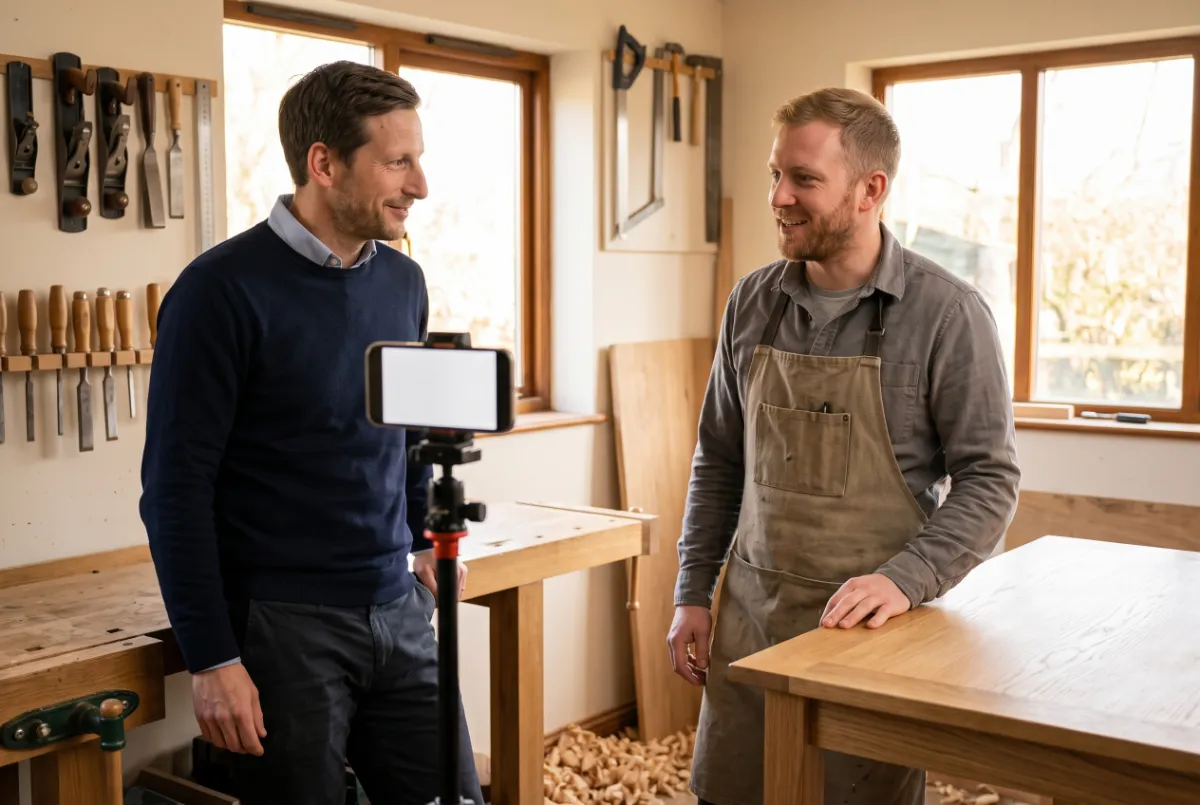
Daniel Andrews helping a carpenter set up a phone on a tripod to film a short video in his workshop
Sound familiar?

Marketing at 10pm, or not at all

You didn't start a business to spend your evenings writing captions. You started it to be your own boss. When the marketing only happens after the children are in bed, the business is running you, not the other way round.

“I do the posts at 10pm. When I do them at all.”
“I open Facebook and have no idea what to post.”
“Filming myself feels so awkward.”
“The agency cost a fortune, and it never sounded like us.”
“Our website hasn't been touched in years.”
“Our competitors seem to be everywhere.”

What is AI content creation for small business?

It means using AI tools to draft your marketing faster: social posts, captions, short video scripts, web pages and guides. You bring what only you know, such as your jobs, your customers' questions and your opinions. The AI turns that into drafts in your voice, and a person checks and approves everything.

The AI is the easy part. The hard part is knowing what to say, week after week. That's a problem to solve before any tool gets switched on.

Solving problems is what I've done for 20 years, and the method doesn't change: pull everything together, see what's going on, then fix it so it stays fixed. For your marketing, that looks like this.

  • Pull it together. What you do, what customers ask, what your reviews say and the work you're proudest of.
  • Find what to say. The questions people ask before they buy become your content plan.
  • Make it repeatable. A voice guide, templates and checks, so every month runs the same way.
  • You approve. Nothing is posted until you, or someone you trust, has read it.

What does the system look like in practice?

Once a month you get a content plan built from your customers' real questions. AI drafts the posts, captions, reel scripts and any web pages in your voice. Automatic checks look for mistakes, then you approve the batch in one sitting. Everything is scheduled, so posting carries on while you work.

Where the evenings go now, and what the system does instead
JobNowWith the system
Deciding what to postA blank screen at 10pmA monthly plan built from real customer questions
Writing postsFrom scratch, every timeDrafts in your voice, ready for you to edit
ReelsPut off, because filming feels awkwardA short script to film on your phone, or a simple animated reel with no people in it
Captions and alt textRushed or skippedDrafted with each post, so videos carry captions and images carry alt text
Web pages and guidesUntouched for yearsPages and guides drafted from the same customer questions
CheckingWhatever you spot when you're tiredAutomatic checks for spelling, your own rules and anything that names a customer
PostingWhenever you rememberScheduled in advance, once you've approved it

Want to see how this would work for your business? Tell me what you sell and who buys it.

Book a free 30-minute call

Where do social media content ideas for small business come from?

Mostly from your own inbox and phone. The questions customers ask before they buy, the worries they raise, the jobs you finished this week and the things your reviews praise are all content. AI helps sort them into a plan, then turns each one into a post, a reel script or a page.

  • The question you answer on every quote, call or appointment.
  • A myth in your line of work that you're tired of correcting.
  • A job from start to finish, shown with the customer's permission.
  • What your reviews keep mentioning, quoted exactly and with the reviewer's agreement.
  • Seasonal reminders: the jobs people forget until it's too late.
  • A normal day in the workshop, the salon or the office, with your team's agreement.

A plumber, a salon and an accountancy firm will each have different questions. That's the point. Your customers' own words make better posts than any list of generic ideas.

Do I have to film myself to make reels?

No, although a short clip of you talking often feels more personal. You can film your hands and your work instead of your face, or read from a short script. Some reels need no filming at all: simple animated videos built from text. AI can draft the script and the captions, and help trim the clip.

Is AI video good for business promotion?

Used carefully, it helps. AI video tools can add captions, cut a long clip into short reels and build simple animated videos from text. What I won't do is make AI video of a real person, whether a customer, a member of staff or you, without their agreement. Realistic AI video may also need a label.

Each platform has its own labelling rules, covered in the section on AI labels below.

What is AI good at, and where does it go wrong?

AI is good at first drafts, turning one idea into several formats and tidying your wording. It's poor at facts, local detail and sounding like you without help. The NCSC warns that it can get things wrong and present them as fact, so a person checks every draft.

The same goes for your website. Google's guidance on generative AI content says AI can help with research and structure. It also says using AI to churn out many pages that add nothing for readers may break its spam policy on scaled content abuse. That's why every page in the system starts from a real customer question and your own knowledge.

Where AI helps

  • A first draft in seconds, not an evening
  • One idea turned into a post, a reel script and a web page
  • Captions and alt text for every post
  • Tidying spelling and tone
  • Fresh angles when you're stuck

Where you're needed

  • The facts: dates, rules and anything about price
  • Your opinions and your stories
  • Local knowledge nobody else has
  • Whether it sounds like you
  • The final yes before anything goes out

Which AI tools would I use?

Usually a small set, chosen around what you already pay for. An AI assistant such as ChatGPT, Claude or Microsoft Copilot drafts the words. A design tool such as Canva handles graphics and simple reels. A video editor such as Descript tidies phone footage, and a scheduler posts everything at the right time.

Example tools, by job
JobExamplesWorth knowing
Drafting wordsChatGPT, Claude, Microsoft CopilotUse a business account and keep customer details out of it
Graphics and simple reelsCanvaIts Brand Kit, on the Pro plan, keeps your logo, colours and fonts in one place
Editing phone videoDescriptYou edit the video by editing its transcript, and it can add subtitles
Scheduling postsMeta Business Suite, BufferMeta Business Suite is Meta's free scheduler for Facebook and Instagram posts, stories and reels. Buffer also covers LinkedIn, TikTok and Google Business

Examples, not recommendations. I have no affiliate deal with any software company, and nobody pays me to mention them. Features and prices change, so we'll check each supplier's own website together before you sign up to anything.

If your team will be drafting the posts, AI training for your team shows them how to use these tools well and check what comes out. And before anyone pastes in customer details, read my guide on whether ChatGPT is safe for business.

What rules apply to AI marketing content in the UK?

The same rules as any other marketing. The CAP Code applies however the content was made, and it covers much of what a business posts on its own website and social media. Your marketing must not mislead, must be clear that it's marketing, and must only use genuine reviews.

The ASA calls the CAP Code media-neutral: the rules apply whether a person or a machine made the ad. It warns that a fake celebrity endorsement made with AI, convincing enough to mislead, is likely to break the Code. There's no blanket legal requirement in the UK to say you used AI. The ASA suggests asking whether your audience would be misled if you didn't.

Two rules come up most often. Rule 3.1 says marketing must not materially mislead, and rule 2.1 says it must be obviously identifiable as marketing. The ASA's advice on social media says posts on a business's own channels can be covered where they're directly connected with what it sells.

Can AI help with reviews and testimonials?

It can help you ask for reviews and share them, but it must never write them. Fake reviews are a banned practice under the Digital Markets, Competition and Consumers Act 2024. The CMA describes a fake review as one that claims to be based on a person's genuine experience, but isn't.

The CMA's fake reviews guidance lists buying reviews that were really produced by software, such as bots, as a banned example. Under the CAP Code, you must hold evidence that a testimonial is genuine, with contact details for the person who gave it (rule 3.47). You must also make it clear when a review was incentivised (rule 3.45).

So in the system, reviews are quoted word for word and never rewritten by AI. A customer is never named without their permission.

Can I use photos and videos of customers, staff or children?

Only with care, and usually with permission. If someone can be recognised in a photo, it's normally their personal data under UK GDPR. The ICO says using customers' or staff photos in marketing needs its own lawful basis, and in its example the business asks for consent first. Children need extra protection.

The ICO's point about recognisable faces comes from its advice on taking photographs. Staff need particular care. The ICO says consent is harder to show as freely given where there's an imbalance of power, such as between employer and employee. So give people a real choice, keep a record, and make it easy to change their mind later.

For children, UK GDPR says they merit specific protection, particularly when their data is used for marketing. If in doubt, leave them out.

My rule: I never make AI images or video of a real person, whether a customer, a member of staff or you, without that person's agreement. And no customer is ever named without their permission.

Do I need to label AI content on Facebook, Instagram, TikTok or YouTube?

Sometimes. Each platform sets its own rules, and they mostly target content that looks or sounds real. Meta may require a label on realistic video or audio made or changed with AI. TikTok and YouTube ask creators to label AI content showing realistic people or scenes. Scripts and captions written with AI generally don't count.

What each platform's own help pages say (checked 30 September 2026)
PlatformA label is needed whenWorth knowing
Facebook and InstagramVideo that looks photo-real, or audio that sounds real, has been created or altered digitally, including with AIThe requirement doesn't cover images, but Meta may still label an image its systems detect as AI-made. Missing labels can bring penalties
TikTokAI-generated or heavily edited content shows realistic-looking people or scenesUse TikTok's AI-generated content label or your own clear caption, sticker or watermark. Unlabelled content may be removed, restricted or labelled by TikTok
YouTubeA real person appears to say or do something they didn't, real footage is altered, or a realistic scene is shown that never happenedUsing AI for an outline, script, thumbnail or captions doesn't need disclosing. You declare it in YouTube Studio when you upload

No. Photos, illustrations and music recordings are usually protected by copyright, so you need the owner's permission or a licence. Use your own photos, licensed stock, or the music libraries platforms provide for businesses. TikTok, for example, says businesses can't use its general music library for commercial posts.

The Intellectual Property Office's copyright notice on images explains that photographs are generally protected as artistic works, so you'll usually need the owner's permission. GOV.UK confirms copyright protection is automatic for sound and music recordings too. TikTok points businesses to its Commercial Music Library, which it describes as pre-cleared for commercial use.

Regulated business? Financial advisers, brokers, solicitors, accountants and others may have their own marketing rules on top of these, such as the FCA's guidance on financial promotions on social media or the SRA's rules on publicity. Check with your regulator or compliance adviser before you post.

This section is general information from official sources, checked on 30 September 2026. It isn't legal advice, and this consultancy isn't regulated by the SRA. For your own situation, speak to a solicitor or other qualified adviser.

In my own firm

The marketing system running in my own firm

For years I worked 60 to 70 hours a week, often until 2am. What changed that was putting the firm on systems, and marketing was one of them. The firm is now four to five times the size it was when I started.

I'm Managing Partner of a multimillion-pound law firm with two offices and around 30 people. In a law firm, one careless post could name a client or break a rule, so every draft passes automatic checks before a person reads it and approves it.

I built it in my own firm first, and I can build it for yours. This consultancy is new, so there are no client results to show yet. What I can show you is the system at work.

  • One workflow, four kinds of content. Web pages, guides, social posts, and short videos and reels, all drafted with AI.
  • Automatic checks. Spelling, the firm's own rules, and a check that no client is ever named.
  • A person approves. Nothing goes out until someone has read it and signed it off.
  • A solicitor's habits. Trained to get to the facts, keep confidences and get the detail right. This consultancy gives no legal advice and isn't regulated by the SRA.

Do I need a content creator for my small business, or a system?

A content creator makes content for you, which works for as long as you keep paying. A system helps you make your own, in your voice, from what you already know. I either set the system up for you to run, or help you run it each month. Either way, you approve everything.

SET UP FOR YOU

I build it, you run it

I pull everything together and build your content plan, voice guide, templates and checks. Then I train you, or someone on your team, to run it. After that, it's yours.

RUN WITH YOU

We run it together

I set it up, then help you run it: planning each month, drafting, checking and scheduling. You still approve every piece before it goes out.

Not sure marketing is the right place to start? An AI readiness assessment shows where your week goes. The system can also link up with business automation, so a finished job prompts a polite request for a review.

  1. Talk

    A free 30-minute call about your business, your customers and where you post now.

  2. Pull it together

    What you do, what customers ask and what your reviews say, gathered in one place.

  3. Build the system

    Content plan, voice guide, templates and checks, using tools you already have where possible.

  4. Approve and post

    You approve the first month's drafts, then they're scheduled. We adjust as we learn.

Questions people ask

Questions about AI content creation

Will it sound like me?

That's the first thing we work on. I build a short voice guide from how you talk and write: your emails, your replies to reviews and a conversation with you. The AI drafts from it, you change anything that doesn't sound right, and your changes go back into the guide.

Will it get me more followers or more leads?

I can't promise that, and I'd be wary of anyone who does. What the system does is make regular, useful posting realistic for a busy owner. What happens after that depends on your business, your market and your customers.

How much of my time will it take?

Some, and it should. You'll answer questions for the plan, approve the drafts and film if you want to be in the reels. The aim is one planned sitting in working hours, rather than bits and pieces at night. We'll agree a routine that fits your week.

Is it just social media, or the website too?

Both. Social media content creation for small business is where most owners start, but the same customer questions make useful web pages and guides. One idea can become a post, a reel script and a page on your website.

Is it safe to put customer information into AI tools?

Keep it out unless the account and your own rules allow it, and marketing content rarely needs personal details anyway. I set up business accounts and simple rules. My guide on whether ChatGPT is safe for business explains more. This is practical guidance, not legal advice.

Do I need to be on every platform?

No. It's better to do one or two places well than five badly. We'll look at where your customers come from before deciding where to post.

Who owns the content and the accounts?

You do. Everything is built in your accounts, under your logins. The content plan, voice guide and templates are yours to keep, whether or not we carry on working together.

Start with the questions your customers ask

A free 30-minute call. No jargon and no hard sell. Bring the three questions you answer most often, and we'll sketch how they could become posts, reels and a page on your website.