
“Forty maintenance contracts, all due at different times, and the only list is a spreadsheet I'm scared to open.”
Fire and security software that keeps every service visit in sight. And weekends that aren't spent on certificates.
Visits booked, records sent and renewals invoiced on a system, so your evenings are yours and the contracts keep running when you're on holiday.
I'm Daniel Andrews. The East Sussex law firm I run works on systems I built. Now I help fire alarm, intruder alarm and CCTV installers around Bexhill, Eastbourne and Lewes clear the paperwork from their evenings.
A typical evening, after a day of installs and services
- 6pmFinishing today's service recordsAlarm visit, emergency lighting test, two defects to price
- 7pmChecking who's due next monthDates spread across three spreadsheet tabs
- 8pmPricing a CCTV upgradeCameras, recorder, cabling and where the signs go
- 9pmRenewals and a police letterContracts to bill, and a shop's second false alarm
- 11pmBed, on call for panel faultsA care home panel can fault any time
Good contracts, buried in admin
Overheard at the wholesaler's counter.
“Half my income is service contracts, and I only invoice a renewal when I notice it's lapsed.”
“My partner stopped asking when I'll be finished. The answer is always after the service sheets.”
“I quote a camera system on Tuesday, forget to follow up, and hear on Friday they went elsewhere.”
“A fire officer asked my customer for their logbook, and my last visit record was still in the van.”
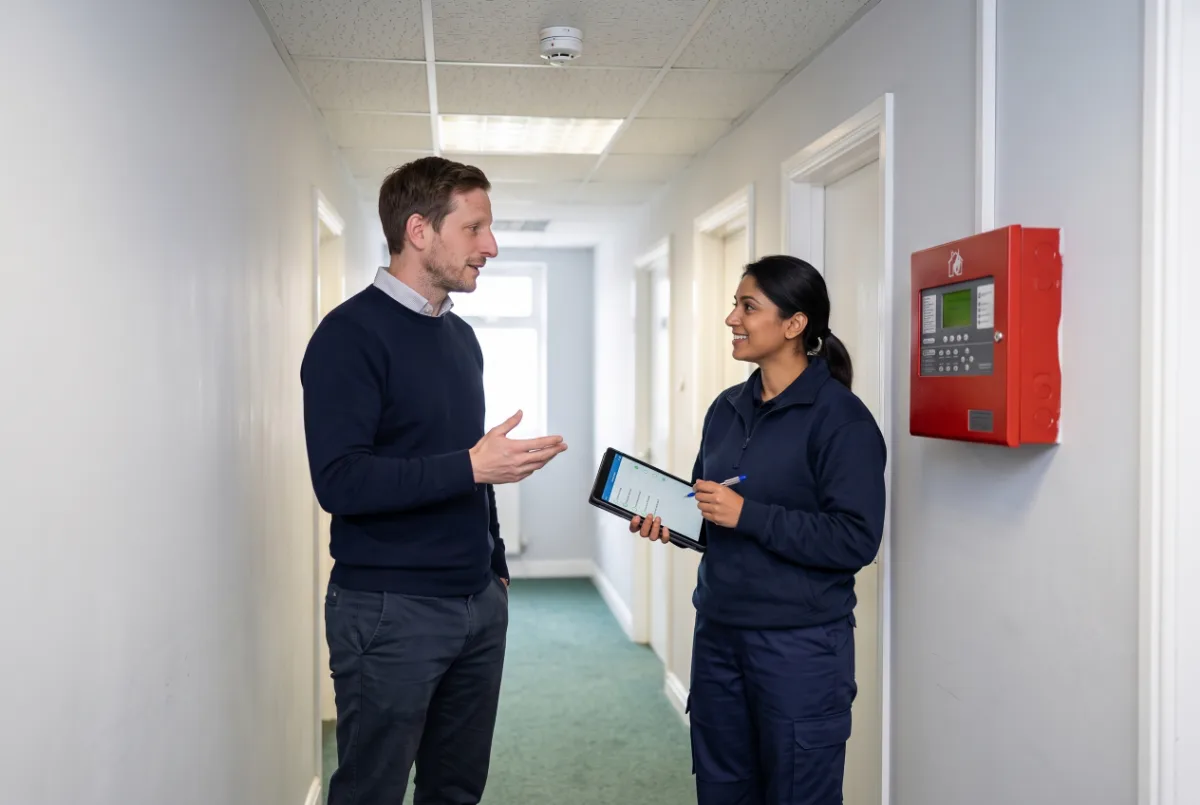
Recurring contracts should buy you freedom. Often they buy you a job.
You started out alone to pick the work and the hours, and fire and security ought to suit that: contracts renew and visits repeat. Yet every date, record and renewal still runs through you. If you were off for a month, would anyone know which alarms were due, or where last year's records were? If not, you've built a job, not a business.
I did the same, for years. I worked 60 to 70 hours a week, often until 2am. Putting my firm on systems changed that, and it's now four to five times the size it was when I started.
What changed it was a system: see where the time goes, put the repeat work on systems, and spend the hours you win back on the business. For your contracts, that means every site and system in one place, visits booked from each contract, and records and invoices sent without you. With the routine written down, an engineer you take on can follow it. My page for trades stuck doing admin at night explains why it happens to so many trades.
What should fire and security software do for a small installer?
It should hold every site and system, from fire alarms and emergency lighting to CCTV and intruder alarms, with visit dates set by each contract. It should produce the service record on site, send it to the customer, log alarm activations, raise renewal invoices on time and keep a history you can find when asked.
| Job | How it often works now | Set up properly |
|---|---|---|
| Enquiries | New systems, faults and takeovers, all by phone. | One form asking the system type and premises, with faults routed to you first. |
| Surveys and quotes | Priced late at night, follow-ups forgotten. | Templates for common systems, survey photos attached, follow-ups on set days. |
| Service visits | Due dates in a spreadsheet. | Each contract sets its own visit pattern, and customers are asked to book before it's due. |
| Service records | Written on paper, typed up later. | Completed on your phone, sent to the customer and filed against the site. |
| Monitoring and false alarms | Police letters and monitoring emails lost in the inbox. | Every activation logged against the site, with a flag after a false alarm. |
| Renewals and invoices | Billed when you remember. | Invoices raised on each contract anniversary, with reminders until paid. |
What do the rules say about alarm maintenance, police response and CCTV?
The responsible person for a building must keep its fire safety equipment maintained and working. Home Office guidance for small premises has a competent contractor inspect fire alarms every six months and emergency lighting yearly. Police response to intruder alarms follows national requirements, and CCTV can bring data protection duties.
Fire alarms and emergency lighting
GOV.UK says the responsible person can be an employer, owner, landlord, occupier or managing agent. Article 17 of the Regulatory Reform (Fire Safety) Order 2005 requires a suitable system of maintenance. The Home Office guide for small premises adds weekly alarm tests and monthly lighting checks by the premises, recorded in a logbook or electronically. Your visit record becomes part of their evidence.
Blocks of flats
Since 23 January 2023, the Fire Safety (England) Regulations 2022 have required monthly checks in residential buildings of at least 18 metres or seven storeys, covering equipment such as fire detection and alarm systems. A fault not fixed within 24 hours must be reported to the fire and rescue service. So record fault and repair times accurately.
Intruder alarms and police response
Under the NPCC security systems requirements, an installer needs certification from a UKAS-accredited body to fit systems for police response. A system with a police URN gets an immediate response until three false calls in a rolling 12 months. After two, the customer is warned in writing, copied to the maintaining company. After three, response is withdrawn.
CCTV and UK GDPR
The ICO says home CCTV that records beyond the property boundary brings data protection law into play. For small businesses, its checklist for limited CCTV systems covers camera positions, signs, storage for a set period and handling requests. The ICO notes that guidance is under review after the Data (Use and Access) Act.
- Six-monthly alarm and yearly lighting visits booked from the contract, not from memory.
- A false alarm count on each monitored site, so the second one triggers a visit before a third.
- A CCTV handover sheet with camera views and retention settings, and the ICO checklist linked.
Please note: this is general information from official sources, not legal advice. For your own situation, speak to your certification body, the fire and rescue service, your accountant or a solicitor.
How many of your contracts renew next quarter? If you'd have to look it up, let's talk.
Book a free 30-minute callWhat I'd set up first for a fire and security installer
Contracts first: they're income you've already won.
One register of sites and systems
Every site, system and contract in one list, built from your spreadsheet and invoices, with each next visit date.
Visits that book themselves
Customers get a reminder with a booking link before each visit is due, and confirmed slots drop into your diary.
Records sent from site
The service record goes from your phone to the customer and the site file, and defects become a draft quote.
Renewals billed on the day
Anniversary invoices go out automatically, with polite reminders. More on getting invoices paid without chasing by hand.
How do I choose fire and security software?
Look for software built around sites and systems, not one-off jobs. It needs to schedule recurring visits by contract, record service results and defects on a phone, cover fire, intruder, CCTV and access control, log activations, raise renewal invoices, connect to your accounts and export everything.
- Visit patterns per contract, such as six-monthly alarm and yearly emergency lighting visits.
- Service forms you can shape to the paperwork your certification body expects.
- Links to your accounts. Sole traders over £30,000 of qualifying income move to Making Tax Digital for Income Tax in April 2027. Your accountant will know your year.
Examples of fire and security software for UK work, not recommendations: Joblogic has separate fire safety and security company pages, Uptick offers its fire inspection software in the UK, and Klipboard stores certificates against each site. I have no deal with any of them.
A missed renewal causes trouble in law too
In law, a missed renewal date or an unfiled record causes real trouble. I'm Managing Partner of a two-office law firm in East Sussex, with around 30 people. I built it in my own firm first: our numbers reach a live dashboard without anyone building a report, and hand-offs between colleagues are signed off in one click.
I'm a practising solicitor as well, so getting the facts straight and the detail right is second nature. A fire logbook needs the same care. This consultancy doesn't give legal advice, and it isn't regulated by the SRA.
The consultancy is new, so no fire and security firms are clients yet. I've spent 20 years in BNI alongside local owners. And with two children and a football team to coach, I understand wanting your weekends back. Read my background.
Other trades I help
 Plumbing
Plumbers
Call-outs answered, quotes built from your price list, parts matched to jobs and notifications tracked, so the van isn't your evening office.
For plumbers Electrical
Electricians
Certificates written up on site, EICR recalls sent to landlords, remedials quoted and invoices chased, so testing days don't become writing-up nights.
For electricians Building
Builders
Quotes, variations, subbies and the monthly CIS return, set up so the office side of a building firm stops eating your evenings.
For builders Gas and heating
Gas and heating engineers
Every landlord check and boiler service on one due-date list, records sent from site, and boiler quotes followed up, so winter weekends stay yours.
For gas and heating engineers Locksmithing
Locksmiths
Lockouts caught while you're mid-job, key and job records kept straight, and the invoice sent before you've left the doorstep.
For locksmiths Gardening
Landscape gardeners
For gardeners and landscapers juggling a maintenance round, bigger landscaping quotes and green waste records through a long summer of late nights.
For landscape gardenersQuestions from fire and security installers
How often should a fire alarm be serviced?
For small non-domestic premises, the Home Office guide says every six months by a competent contractor, plus a weekly test by the premises. The fire risk assessment sets what each building needs.
What happens after false alarms on a monitored intruder alarm?
Under the NPCC requirements, two false calls in a rolling 12 months bring a warning letter. A third means police response is withdrawn, and reinstatement follows remedial work or three months free of false calls.
Does a customer's CCTV have to follow UK GDPR?
For a business using it to capture identifiable people, yes. At home, the ICO says it applies once cameras record beyond the property boundary. The duty sits with the customer, but a clear handover sheet helps.
Is fire and security software different from general job software?
Mostly in the recurring side: sites, systems, visit patterns and service forms. A general system can work if it handles contracts well. For wiring work, see my page for electricians.
Let the service calendar run itself, and keep your evenings
A free 30-minute call. No jargon and no hard sell. Tell me how you track visits and renewals now, and I'll show you the first thing I'd automate.