
“A blocked soil stack at 1am, a CCTV report owed to a buyer's surveyor, and I haven't invoiced last week.”
Drainage company software that keeps pace with the emergencies. Evenings that belong to you again.
Call-outs sorted, reports written and contract visits booked without you at the laptop, and a drainage firm that still runs on your nights off.
I'm Daniel Andrews. I run a law firm in East Sussex, and the systems it runs on are ones I built. Now I help drainage engineers from Seaford to Crowborough get the admin off their evenings and turn a van and jetter into a proper business.
A typical evening, after a day of blockages
- 6pmWriting up the morning's CCTV surveyDefects, distances and stills for a buyer's surveyor
- 7pmWorking out whose pipe it isPrivate drain, lateral or shared sewer, before you quote
- 8pmBooking next month's contract workGrease traps for three takeaways, jetting for a care home
- 9pmInvoicing agents and insurersEach wants its own order number first
- 11pmLights off, still on callFlooded toilets don't wait for office hours
Clear drains, full inbox
Heard once the jetter's packed away.
“Every blocked drain is an emergency to the person ringing, and I'm usually mid-job with the jetter running.”
“Sunday dinner goes cold every time the phone goes. And it always goes.”
“Agents want a purchase order number before they'll pay, and I never have it to hand.”
“I quoted to replace a collapsed pipe, then found out it was a shared sewer and never ours to fix.”
If you're the only one who can read the camera footage, it's a job
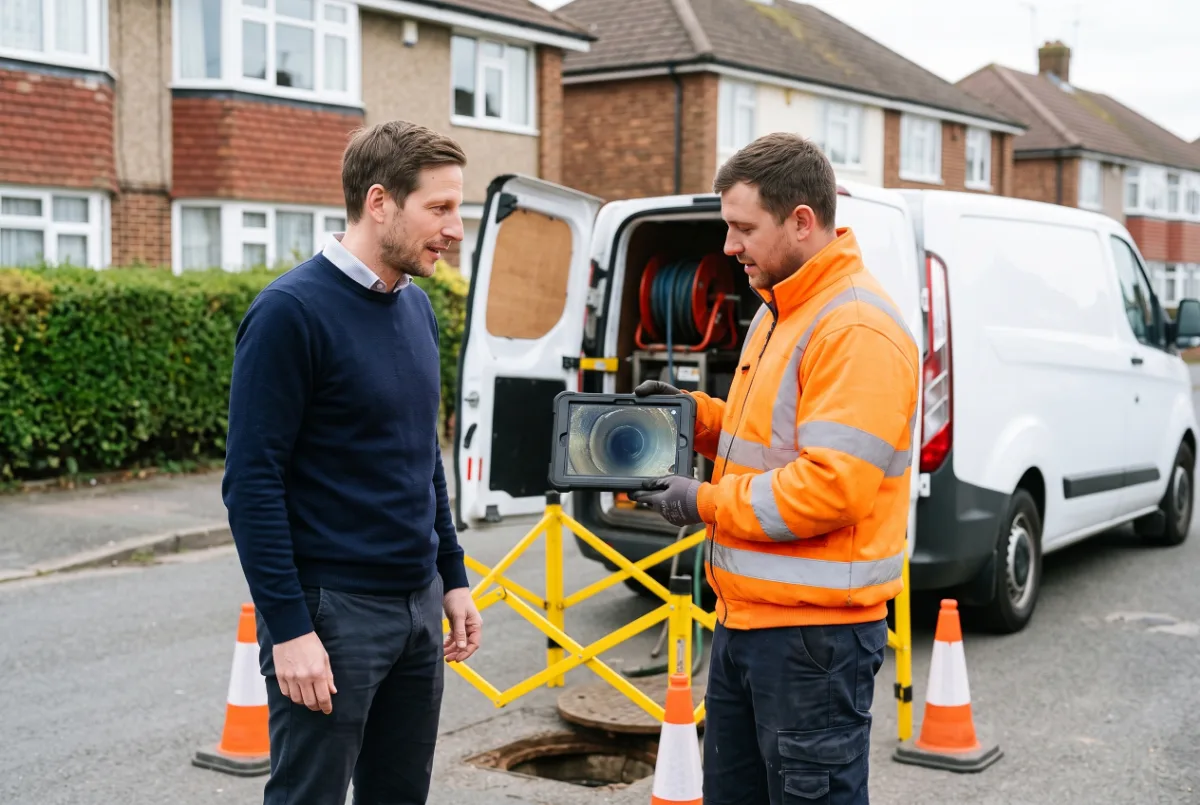
Going self-employed should have meant picking your own hours. In drainage, the blockages choose them, from Seaford to Hastings, and the survey write-ups and invoices wait for you at home. If a bad back kept you off the tools for a fortnight, would the contract visits still happen and the reports still go out? If not, you've built a job, not a business.
I've been in that position. For years I worked 60 to 70 hours a week, often until 2 in the morning. Putting my firm on systems changed that, and it's now four to five times the size it was when I started.
What fixed it was a system: see where the time goes, put the repeat work on systems, and spend the hours you win back on the business. For a drainage firm, that means enquiries sorted by urgency without you, reports and quotes drafted from site notes, and contract work booked a year ahead. With each job written down, a second engineer could pick it up while you take a week off. I explain the wider idea on the page for trades who've built a job instead of a business.
What should drainage company software do for a small drainage firm?
It should sort call-outs by urgency, keep CCTV survey findings and photos against each property, and turn them into a report and a repair quote. It should schedule contract work such as grease trap and jetting visits, record order numbers for agents and insurers, raise invoices on completion and follow them up.
| Job | How it often works now | Set up properly |
|---|---|---|
| Blockages and floods | Picked up from the van, or missed and returned at midnight. | A text back asking what's backing up, where, and for a photo, with indoor flooding flagged first. |
| Repair and relining quotes | Written at night from memory and camera stills. | A template per repair type, filled from the survey notes, sent next morning. |
| CCTV survey reports | Typed up from footage at the kitchen table. | Each observation logged on site with a still, and the report drafted for you to check. |
| Whose pipe is it? | Worked out on the doorstep, sometimes after quoting. | Two questions at booking: does it serve one property, and is the problem inside the boundary? |
| Maintenance contracts | Visit dates kept in a paper diary. | A year of visits created from each contract, each with an emailed service sheet. |
| Invoices and chasing | Order numbers hunted down at the weekend. | The order number taken at booking, the invoice sent on completion, then reminders. |
Who is responsible for which drain, and what rules apply to the work?
Since 1 October 2011, shared private sewers and lateral drains connected to the public network in England have belonged to the water company. Owners keep pipes serving only their property inside its boundary. HSE treats enclosed drains and sewers as confined spaces. Building regulations guidance expects commercial hot food kitchens to have effective grease removal.
Private drain, lateral drain or public sewer
Defra's notice of the transfer on 1 October 2011 explains that pipes shared by two or more properties, and lateral drains outside a single property's curtilage, passed to the water companies. In East Sussex, both Hastings Borough Council and Rother District Council name Southern Water as the company responsible for sewers. A report showing where a defect sits against the boundary saves an argument later.
Confined spaces
HSE's guide to working safely in confined spaces lists enclosed drains and sewers, and warns that a manhole entrance makes rescue harder. The duties are to avoid entry where possible, use a safe system of work if you can't, and plan emergency arrangements first. The Confined Spaces Regulations 1997 apply to the self-employed as well as employers.
Grease and food businesses
Paragraph 2.21 of Approved Document H says drainage from kitchens in commercial hot food premises should have a grease separator or another effective way of removing grease. Under section 111 of the Water Industry Act 1991, letting anything into a public sewer that's likely to interfere with its flow is an offence. A dated service sheet from every grease visit matters to the café owner as much as to you.
- Booking questions that spot a likely sewer problem before you set off.
- A confined space checklist on the job sheet, completed before any entry is logged.
- Grease trap visits booked from the contract, with the service sheet emailed on the day.
Please note: this is general information from official sources, not legal advice. For your own situation, speak to HSE, building control, your accountant or a solicitor.
How many of last month's call-outs came after dark? Tell me, and I'll point out what could happen without you while you're on them.
Book a free 30-minute callWhat I'd set up first for a drainage engineer
Emergencies first, because they go to whoever answers. Then the paperwork.
Triage the emergencies
A missed call gets a text asking what's backing up, inside or out, the postcode and a photo. See how an AI receptionist handles missed calls.
Survey, report, quote
Observations and stills logged on site become a draft report and repair quote, checked by you before they go.
Contracts on the calendar
Grease trap, jetting and maintenance visits created for twelve months, with service sheets sent automatically.
Order numbers before invoices
Agents, insurers and facilities managers give their reference at booking, so the invoice goes out complete.
How do I choose drainage company software?
Choose software that holds emergency and planned work in one diary, stores CCTV survey stills and findings against the property, and builds reports and quotes from your site notes. It should schedule recurring contract visits, record order numbers, work offline at the bottom of a garden, link to your accounts and export everything.
- Survey findings, stills and video links kept against the address, not on a memory card.
- Recurring grease trap and maintenance visits, each with a service sheet.
- A link to your accounting software. Making Tax Digital for Income Tax began in April 2026, for sole traders above £50,000 of qualifying income. Ask your accountant when it reaches you.
- A full export, so your survey history stays yours.
Examples, not recommendations: Joblogic covers CCTV, planned and reactive drainage work, Klipboard lists CCTV surveys among the records it keeps, and BigChange names jetting, tankering and surveys as work it's built for. None of them pays me.
Whose pipe is it? Law asks the same question
Much of law comes down to who is responsible for what, the same question behind many drainage calls. I'm a practising solicitor, so I'm used to getting the facts straight and the detail right. This consultancy doesn't give legal advice, though, and isn't regulated by the SRA.
I'm also Managing Partner of a two-office law firm in East Sussex, with around 30 people. There, a live dashboard pulls figures from the case management system, and colleagues hand tasks to each other with approvals built in.
My consultancy is new, and no drainage firms are on its books yet. I've spent 20 years in BNI, though, so I know how local firms run. Read more about me and my background.
Other trades I help
 Plumbing
Plumbers
Call-outs answered, quotes built from your price list, parts matched to jobs and notifications tracked, so the van isn't your evening office.
For plumbers Electrical
Electricians
Certificates written up on site, EICR recalls sent to landlords, remedials quoted and invoices chased, so testing days don't become writing-up nights.
For electricians Building
Builders
Quotes, variations, subbies and the monthly CIS return, set up so the office side of a building firm stops eating your evenings.
For builders Gas and heating
Gas and heating engineers
Every landlord check and boiler service on one due-date list, records sent from site, and boiler quotes followed up, so winter weekends stay yours.
For gas and heating engineers Locksmithing
Locksmiths
Lockouts caught while you're mid-job, key and job records kept straight, and the invoice sent before you've left the doorstep.
For locksmiths Gardening
Landscape gardeners
For gardeners and landscapers juggling a maintenance round, bigger landscaping quotes and green waste records through a long summer of late nights.
For landscape gardenersQuestions from drainage engineers
Is drainage company software the same as drainage design software?
No. Much of what appears for "drainage software" is for civil engineers designing drainage schemes. Software for a drainage company runs the business side: call-outs, surveys, quotes, contracts and invoices.
Who should a customer call about a blocked shared sewer?
The water company. In Hastings and Rother, the councils name Southern Water as responsible for sewers. Asking whether the pipe serves more than one property, and where the problem is, sorts most calls early.
Do drain repairs need building regulations approval?
The Planning Portal says a like-for-like repair or replacement of a drain, manhole or fitting doesn't normally need approval, but a new drain, manhole or fitting normally does. Check with building control if you're unsure.
Can a CCTV survey report be written on site?
Often, yes. Many systems let you log each observation with a still as you go, then build the report from those entries, ready for you to check.
Keep the night call-outs. Lose the night paperwork.
A free 30-minute call. No jargon and no hard sell. Walk me through your phone, surveys and contracts, and I'll tell you honestly where I'd start.